
In this guide, you will learn:
- what selling a house with a leaking roof in texas means in practice;
- which inputs, rules, costs, or assumptions change the answer;
- the step-by-step decision process;
- the primary sources to check; and
- when to stop and ask a qualified professional.
The short answer
A leaking roof does not by itself prevent a Texas property sale. It changes the property-condition facts, documents, repair assumptions, insurance questions, financing conditions, and price discussions that the parties may need to resolve. The contract, applicable disclosure requirements, and buyer’s funding path control the specific transaction.
Before choosing repair, credit, price adjustment, or an as-is offer, document the observed leak, obtain qualified assessments where useful, preserve existing invoices and insurance correspondence, and compare written sale paths using the same facts. Request a No-Obligation Offer only if a written as-is comparison would help.
Who this applies to
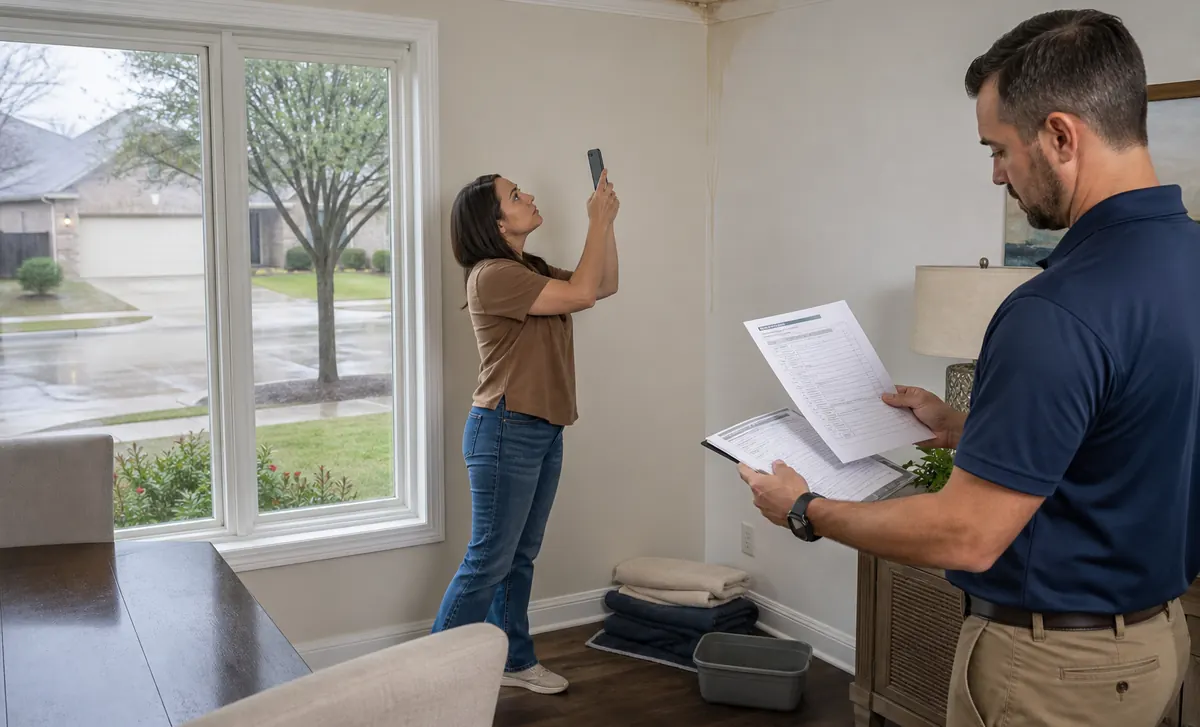
This checklist is for a Texas homeowner who knows or suspects that water is entering through the roof and is deciding whether to repair before marketing, negotiate with a retail buyer, or compare an as-is sale. It is not a roof diagnosis, repair specification, mold assessment, appraisal, insurance-coverage opinion, disclosure opinion, or promise that a buyer or lender will accept the condition.
Keep people away from wet electrical fixtures, unstable ceilings, unsafe attic areas, and active storm conditions. Contact emergency services or qualified contractors when immediate hazards exist. Consult an appropriate Texas attorney, insurance professional, roofer, engineer, appraiser, lender, or environmental professional for questions within their scope.
Inputs and definitions
- Observed condition
- What you can accurately describe without diagnosing a cause: location, timing, visible staining, dripping, missing material, prior work, and documents retained.
- Known defect
- A condition actually known to the seller. Whether and how it must be disclosed depends on Texas law, exemptions, the form, and transaction facts.
- As-is
- A contract allocation of property-condition risk. It does not automatically erase disclosure duties or every negotiated inspection or termination right.
- Repair credit
- A negotiated seller contribution or price treatment. Lender, program, appraisal, and contract requirements may limit or reject a proposed structure.
- Net proceeds
- Contract price minus seller-paid costs, payoffs, credits, repair obligations, and other documented deductions.
Record the roof material and approximate age if documented, leak location and date, visible interior effects, prior repairs, contractor reports, insurance claims or correspondence, occupancy, sale deadline, available repair funds, and each buyer’s written condition requirements.
Step-by-step process
- Protect people and property. Avoid unsafe access and active electrical or structural hazards. Use qualified help for emergency mitigation and diagnosis.
- Document without overstating. Photograph visible conditions, record when they appeared, and retain invoices, warranties, estimates, inspection reports, and insurance correspondence.
- Review disclosure requirements. Use the current Texas statute and applicable form, then obtain legal advice about exemptions or uncertain wording.
- Separate diagnosis from estimate. A contractor’s proposed scope, an inspector’s observation, an insurance adjustment, and an engineering opinion are not interchangeable.
- Obtain written sale paths. Compare repair-before-sale, negotiated retail sale, and as-is offers only when each path states its assumptions.
- Build comparable net sheets. Include price, seller costs, repair or credit amounts, carrying costs, termination rights, and expected dates. Label every uncertain figure.
- Confirm funding and closing conditions. Ask the specific buyer and lender what documentation or property condition they require; do not generalize across programs.
Worked example with assumptions
Hypothetical decision record—not a diagnosis, estimate, or offer
Assume a seller observes a ceiling stain after rain and has one contractor estimate that identifies a proposed repair, but no invasive inspection and no verified damage behind finished surfaces. Path A uses that estimate and a planned listing date. Path B is an as-is written offer that accepts the documented visible condition subject to stated contract rights.
Record the observation, the contractor’s exact scope and exclusions, each contract price, seller costs, repair or credit responsibility, termination rights, closing date, and possession terms. Do not promote one estimate into a final repair cost or state that the roof is fixed without evidence supporting that scope.
Costs, risks, and common mistakes
- Describing a symptom as a confirmed cause.
- Calling a leak repaired when only a temporary patch or dry-weather observation exists.
- Concealing stains, containers, reports, claims, or prior work instead of obtaining advice about accurate disclosure.
- Using an unsupported price reduction or invented repair-cost range.
- Assuming every cash buyer, insurer, lender, appraiser, or loan program treats roof conditions the same way.
- Entering an attic, climbing a roof, touching wet electrical components, or standing beneath unstable material without qualified safety assessment.
- Assuming an as-is clause eliminates every disclosure or contract obligation.
We found no permissioned GetHomeCash sale result or retained primary record appropriate for a public leaking-roof outcome block. We therefore publish no verified savings, price effect, repair cost, closing speed, lender acceptance, customer outcome, or guaranteed result.
Rules or facts to verify now
Texas Property Code §5.008 contains the statutory seller-disclosure framework and form language, including listed roof and water-related conditions, but it also contains exemptions and transaction-specific details. Use the current statute and Texas Real Estate Commission form, and obtain legal advice about whether and how they apply.
For insurance questions, use your policy, insurer, and Texas Department of Insurance consumer resources rather than assuming a roof leak is covered. For financing, ask the actual buyer’s lender or program administrator about the property and proposed repair arrangement. For moisture and mold concerns, use qualified assessment and EPA guidance within its stated scope.
Primary sources
- Texas Property Code §5.008 — statutory seller-disclosure framework and form language.
- Texas Real Estate Commission Seller’s Disclosure Notice — current official form resource; applicability depends on the transaction.
- Texas Department of Insurance storm-damage guidance — state consumer guidance for documenting damage and insurance steps.
- EPA guide to mold, moisture, and your home — federal moisture-control and cleanup guidance within its stated scope.
- Texas Real Estate Commission contract forms — current state-promulgated forms and notices.
Frequently asked questions
How much does a leaking roof reduce value?
No universal percentage applies. The observed condition, diagnosis, repair scope, hidden uncertainty, market, buyer pool, financing conditions, and contract terms can all affect an offer. Obtain property-specific evidence rather than using an unsupported rule of thumb.
Do I need a roof inspection before selling?
No universal answer applies. An inspection or qualified contractor assessment may clarify scope, but disclosure, safety, insurance, financing, and contract questions require the appropriate professional and documents.
Can I sell the property as-is?
An as-is sale path may be available, but the contract language does not automatically eliminate disclosure duties or all buyer rights. Review the specific agreement and applicable Texas requirements.
Should I repair the roof or compare an as-is offer?
Compare documented repair scope, available cash, net proceeds, carrying time, contract conditions, and your deadline. Use qualified advice where safety, legal, insurance, valuation, or financing issues matter.