
In this guide, you will learn:
- what houston property boundary disputes resolution means in practice;
- which inputs, rules, costs, or assumptions change the answer;
- the step-by-step decision process;
- the primary sources to check; and
- when to stop and ask a qualified professional.
The short answer
Start by separating three questions: what the recorded documents describe, what a licensed surveyor finds on the ground, and what each owner claims or has used. A fence or long-standing use is not, by itself, a substitute for reviewing the deed, plat, survey, title records, and applicable law. Do not sign an agreement, move an improvement, or assume ownership rights without advice fitted to the property and dispute.
If a planned sale has a deadline, give the title company, surveyor, and your lawyer the relevant documents early. A boundary question may affect the legal description, exceptions in a title commitment, access, improvements, or what a buyer and lender will accept.
Who this applies to
This guide is for Houston-area owners who see a mismatch involving a fence, driveway, structure, access route, survey marker, deed description, or subdivision plat. It also helps sellers organize facts before asking a surveyor, title company, mediator, or lawyer what to do. It does not determine a boundary or provide a legal opinion.
Inputs and definitions
- Deed
- The recorded instrument conveying an interest in the property; its legal description is one starting point, not a field measurement.
- Subdivision plat
- A recorded map that may show lots, blocks, easements, and other information. Obtain the actual recorded version for the property.
- Survey
- A surveyor's professional work based on records and field evidence. Ask what type of survey and deliverables fit the question.
- Title commitment
- A proposed title-insurance commitment containing schedules, requirements, and exceptions. Read the property description and exceptions rather than treating it as a boundary ruling.
- Encroachment
- A structure or use that may extend across a claimed line or into an easement. Whether it exists and what follows are fact-specific questions.
- Adverse possession
- A legal doctrine governed in Texas by statutes and case law. Time alone does not establish a claim; consult a Texas lawyer.
Step-by-step process
- Preserve the current condition. Photograph the fence, markers, structures, access, and other visible evidence without trespassing or altering anything.
- Collect recorded and transaction documents. Gather the deed, prior surveys, subdivision plat, title policy or commitment, easements, closing documents, and relevant written communications.
- Define the exact mismatch. Mark what each document says, what is physically present, and what each person disputes. Avoid converting assumptions into facts.
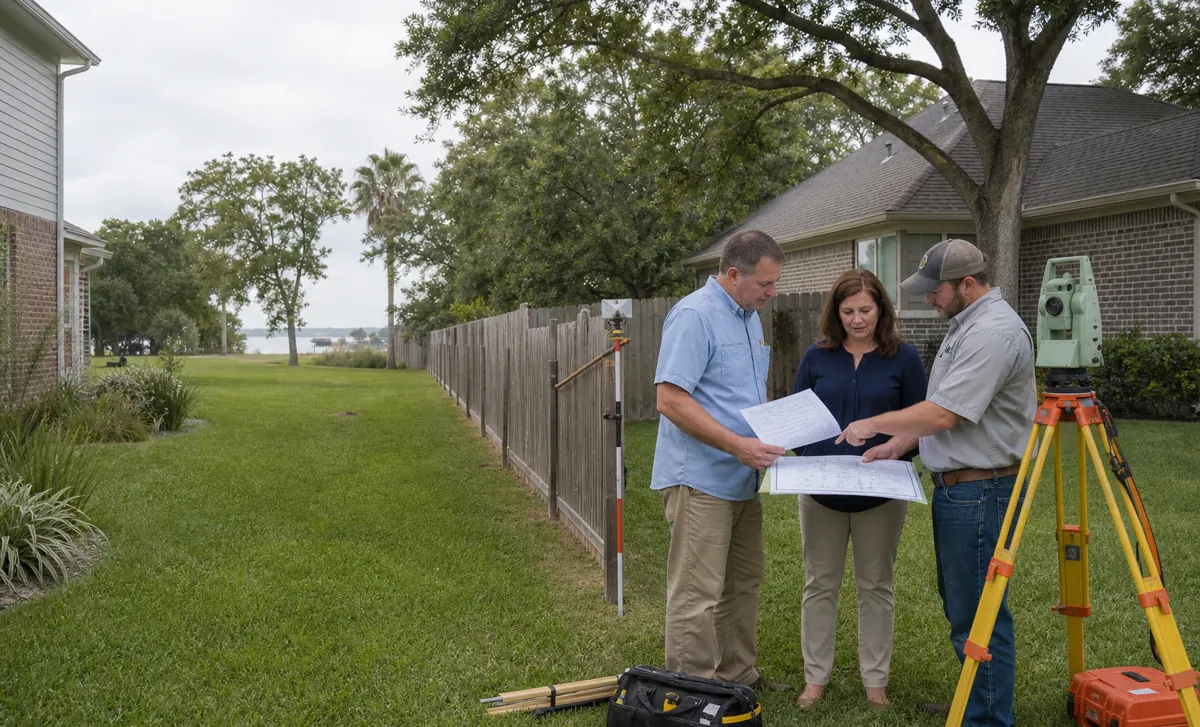
- Ask a licensed surveyor for the right scope. Describe the issue and ask what records, fieldwork, monuments, and deliverables are needed. Verify licensure through the Texas board.
- Notify the appropriate professionals. If a sale, loan, title claim, improvement, access issue, or threat is pending, contact the title company, insurer, lender, or lawyer as applicable.
- Communicate in writing. Keep neighbor communications factual and non-threatening. Do not promise a line adjustment, easement, payment, or waiver before professional review.
- Compare resolution paths. Depending on verified facts, options may include correcting records, a boundary or easement agreement, mediation, a title process, or litigation. A Texas real-estate lawyer should explain legal effect and recording requirements.
- Document and record the outcome. Use approved legal descriptions, signatures, acknowledgments, and recording steps. Confirm that the final documents align with title and closing requirements.
Request a No-Obligation Offer after documenting the issue, or See How It Works.
Worked example with assumptions
Assumptions: An owner preparing to sell finds that an old fence appears several feet away from the line shown on a prior survey. A shed sits near the disputed area. The neighbor has not agreed that either document or feature marks the legal boundary.
The owner preserves photos, retrieves the recorded deed and plat, provides the prior survey to a licensed surveyor, and sends the title company the resulting information. Before moving the fence or shed, the owner asks a Texas lawyer whether an agreement, easement, corrective instrument, or another process fits the verified facts. The example does not predict ownership, cost, timing, or outcome.
Costs, risks, and common mistakes
- Using unsourced price ranges: Survey, mediation, legal, recording, and construction costs depend on scope. Request written scopes and fee terms from the professionals involved.
- Treating a tax map as a survey: Appraisal-district mapping is useful for property-tax research but should not replace recorded documents and professional boundary work.
- Moving evidence too early: Removing a fence, marker, or structure may destroy evidence or escalate the conflict.
- Relying on verbal agreement: A handshake may not create a recordable or enforceable property interest. Obtain legal advice on form, signatures, lender consent, and recording.
- Missing a transaction deadline: Contract, title, financing, inspection, and closing deadlines can continue while a dispute is investigated.
- Assuming long use proves ownership: Adverse-possession questions depend on statutory elements and case-specific facts, not a simple elapsed-time rule.
Rules or facts to verify now
Verify the current deed and legal description, recorded plat and easements, surveyor license, title-policy or commitment terms, contract deadlines, municipal permit or setback requirements, and any claimed adverse-possession period or element. Texas Property Code Chapter 16 contains limitation provisions relevant to adverse-possession claims; a lawyer should determine whether and how they apply.
Primary sources
- Texas Property Code, Chapter 16 — limitations and adverse possession
- Texas Board of Professional Engineers and Land Surveyors — roster search
- Harris County Clerk — real property records search
- Harris Central Appraisal District — real-property advanced search
Frequently asked questions
Does a fence establish the legal property line?
Not necessarily. A fence is physical evidence, but deeds, plats, surveys, monuments, agreements, and applicable law may all matter. Ask a licensed surveyor and lawyer to evaluate the specific facts.
Can the appraisal district map resolve a boundary dispute?
No. Appraisal maps support tax administration and research; they are not a substitute for recorded documents or a professional survey.
Should I move a fence before a survey?
Do not alter potential evidence or enter another person's property based only on an assumption. Preserve the condition and obtain property-specific professional advice first.
Can a boundary issue delay a home sale?
It can affect title review, disclosures, buyer decisions, financing, improvements, or closing requirements. The actual effect depends on the documents, contract, title process, and proposed resolution.